Featured

Environmental Studies Blog #1

Ecological Footprint and Sustainability
Environmental Studies is a study of how the living portions of the environment interact with one another and the nonliving parts of the environment. There are three principles of sustainability, biodiversity, chemical cycling, and the dependence on solar energy. Biodiversity is the variety of genes, species, ecosystems, and ecosystems present in the world. Chemical cycles are the natural methods in which the ecosystem and living organisms have developed to recycle many of the chemicals and other materials required for life back into the ecosystem for reuse. Finally, the dependence on solar energy is the warming of the planet along with the absorption of energy by plants, which can then be converted into nutrients for organisms to consume and use. The earth provides us with plenty of Natural resources that find themselves in three categories, inexhaustible resources, renewable resources, and nonrenewable resources. Using renewable resources at a rate that doesn’t exhaust them is called sustainable yield, and due to many factors, global society has failed to maintain sustainable yield and have overused about 60% of the ecosystem services provided by nature, mostly since 1950” (Miller 2018). Another three additional principles of sustainability come from the societal side of the issue. These principles are Full-Cost Pricing, Win-win Solutions, and Responsibility to Future Generations. These principles deal with the costs, public benefits, and ethics of sustainability.

In 1992 a coalition of the world’s scientists issued a warning to humanity about their abuse of the planet describing it as “irreversible on a scale of centuries, or permanent” (Union of Concerned Scientists 1992). They listed the parts of the global ecosystem that humanity abuses and what issues or threats these abuses present to humanity. These abuses range from the release of carbon-based gases from fossil fuels and other sources into the atmosphere to the lack of sustainable yield in regards to fisheries. Their warning even states some of the shown effects, such as some fisheries financially collapsing. They believed that our tampering with how the world works could result in changes that will forever alter the way earth supports life as we know it, even going as far as to claim some of these changes are irreversible. The most significant pressure on the planet as of now is that the earth itself is a finite resource. It cannot reasonably support the ever-growing population of humanity. However, unlike the common misconception, both developed and underdeveloped countries have unsustainable practices. The coalition of scientists also provided a list of actions that we must take to improve the prospects for humanity. These actions include bringing environmentally damaging activities under control, managing resources more efficiently and effectively, stabilizing the population, reduce and eventually eliminate poverty, and finally giving women gender equality so that they can decide whether or not to have children.

The Millenium Ecosystem Analysis 2 list many of the current issues we must solve to preserve our ecosystem and life as we know it on earth. Three problems with how humanity manages its ecosystems are listed. The first is that near 60% of the ecosystems on the planet are abused and not meeting the standards for sustainable use. The second is that there are established but incomplete evidence that changes being made in ecosystems are increasing the likelihood of nonlinear changes in ecosystems. Finally, the third is that the harmful degradation of the ecosystem is disproportionately caused by the poor.

Four-point one earths, that’s how many we would require if everyone lived life the way I do, and right now, we only have one. Sure there are likely flaws within the ecological footprint test. However, as I went through the quiz, it made me realize exactly how wasteful I can be. I’m an environmental science major with research under my belt; I consider myself reasonably sustainable. But as I answered the questions like how frequently do I consume meat or the miles per gallon of my car, I felt a gut-wrenching feeling. I’ve known and understood sustainable yield as a concept for a while now; it isn’t a complicated concept, just one you have to be told about to think about. But that quiz gave me a realization that despite my conception of myself I still overly contribute to sustainable yield and that quiz didn’t even ask questions about water usage, or how often my other family members who are much less sustainable.

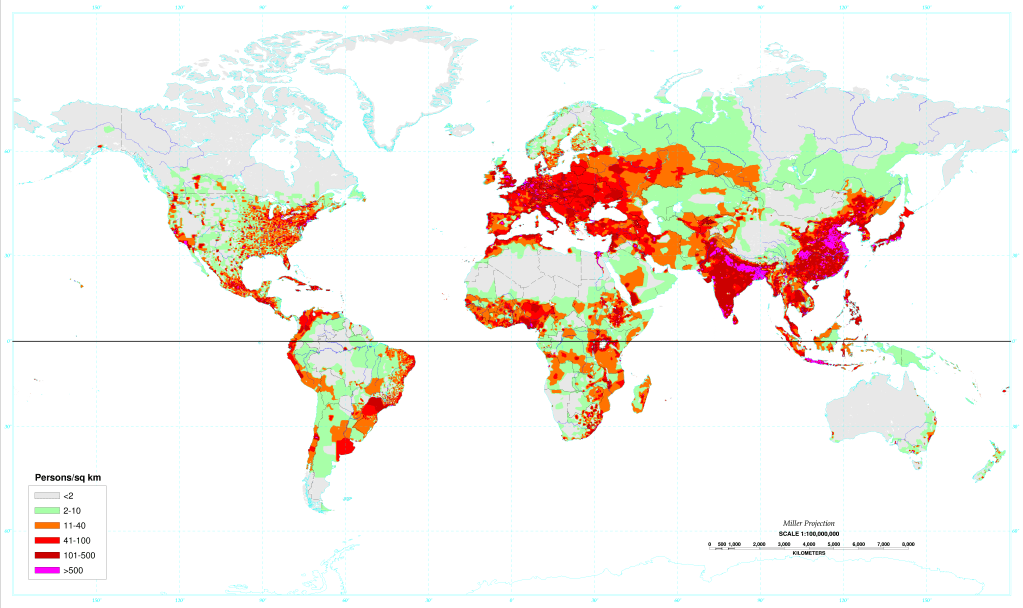
The figure above shows the varying human ecological footprints around the world. The Majority of Europe and the United States of America are a deep red but this map also supports the third issue that the Millennium Ecosystem analysis was highlighting. Many third world and impoverished areas of the world produce a large ecological footprint.

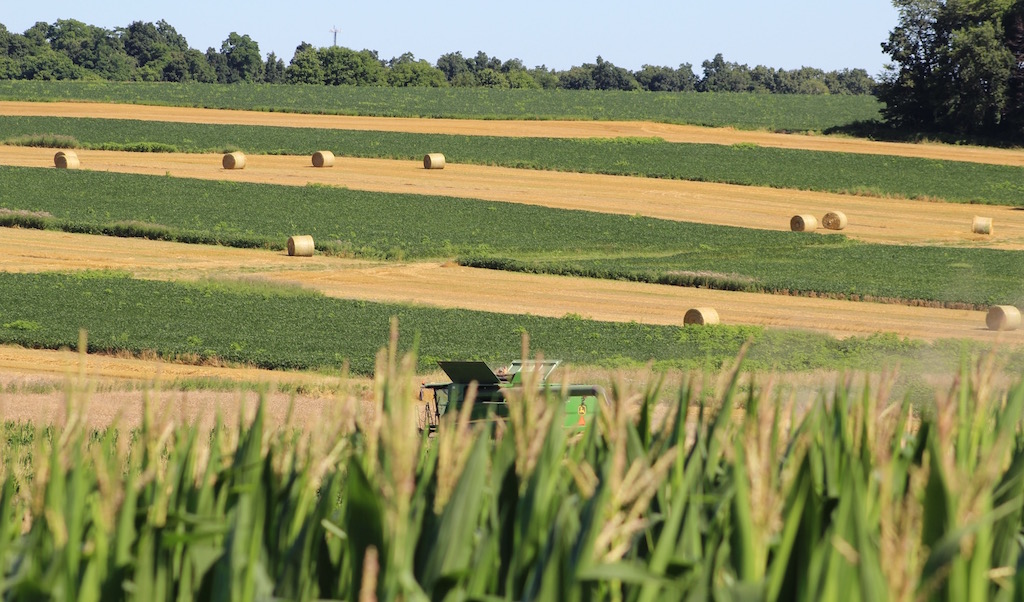
Looking at the numbers only exacerbates the issue. Currently, we have cleared forests and plowed grasslands to grow food on 40% of the earth’s land. 40% of the earth’s land is dedicated just to provide our population with food, and we still deal with starvation and malnutrition. Not to mention that our use of arable land is not meeting sustainable yield requirements. We currently do not have reasonable alternatives to providing food for farming, and yet we are not making any changes to make our farming process more sustainable.

Just last week, I was talking with Dr. Craig Frank, the head of the Environmental Science department, about how arable land is a finite resource and how people do not understand that is an issue. He specifically mentioned to me, “Now when I talk to the big business suit people about how unsustainable our soil practices are, they don’t care until I explain to them ‘you like to eat no?'”. I found reading the additional three principles of sustainability, particularly humorous because of the principle “Win-win solutions” because of Dr. Frank’s quote. However, those win-win solutions still apply, Dr. Frank’s comedic excerpt is a simplification of the more significant issue. Policies are made by what benefits either most people or greatly benefits those in charge. To make a real change, especially those lined out in the warnings, we must convince those who are making the policies that the changes we want are not only for the benefit of the people but can be profitable as well.

The beginning of the textbook chapter opens with an adhesive tape product that was made by mimicking the adhesive mechanics of a gecko’s toe pads. The natural world around us can potentially provide us with numerous benefits and even potential products. As of right now, we only have a small grasp of everything the ecosystems around the world can give us. We must convince companies that protecting this plethora of natural resources and potential designs and products could provide a significant profit.

Discussion questions:

Are the impoverished areas with high ecological footprints because of their poverty and resource consumption or because of their tendency to have high populations and childbirth rates?

Would increasing environmental awareness and education in impoverished areas have a significant enough impact to help decrease their ecological footprints? Or would their situation demand too much for it to be a reasonable option?

Word Count: 1154

Citations:

-Millennium Ecosystem Assessment, 2005. Ecosystems and Human Well-being: Synthesis. Island Press, Washington, DC.

-Miller, George Tyler, and Scott E. Spoolman. Living in the Environment. 19th ed.

-“How Many Planets Does It Take to Sustain Your Lifestyle?” Ecological Footprint Calculator. Accessed January 26, 2020. https://www.footprintcalculator.org/.

-“1992 World Scientists’ Warning to Humanity.” Union of Concerned Scientists, July 16, 1992. https://www.ucsusa.org/resources/1992-world-scientists-warning-humanity.

-“Home Page.” Home Page | World Scientists’ Warning to Humanity. Accessed January 26, 2020. https://scientistswarning.forestry.oregonstate.edu/.
The Anthropocene: Humanity’s End?

Our final topic for this series of blog posts is focused on a passage from The Human Planet: How We Created the Anthropocene, specifically on chapter 11. Here the authors discuss the three outcomes they believe humanity will reach as we continue civilization on earth. The first is we continue in our “capitalist” society but manage to mitigate environmental impacts either through artificial means or through being much more efficient, less destructive, and or conservative in our use of the environment. The second outcome they believe may happen is that we have a complete and total revamp of our society’s ideologies and values and move towards a much more green friendly society that has values that are in line with benefiting the greater ecosystem of the planet. And finally, what is probably the most bleak outcome of society is its collapse due to our destruction of the earth leading to the planet becoming near uninhabitable or making resources so scarce that conflict naturally consumes our capitalist society. We will go through each of these outcomes individually, beginning with the first outcome.

The authors, Simon L. Lewis and Mark A. Maslin, argue that the first outcome is the least likely due “the simultaneous rapid increases in the number of people, level of energy provision and quantity of information being generated, being driven by the positive feedback loops of reinvestment of profit, and ever-growing scientific knowledge” (1). Although I do disagree that this is an unlikely outcome, I also think that their argument for why it is unlikely is somewhat misleading. The main issue I find misleading is “rapid increases in the number of people” (1) in the video I linked in a previous blog post on the population issues in sub-saharan Africa it provided sources and stated that most areas in the world are actually experiencing population declines and that we are already past the peak of the population boom. Although our population is still growing globally, the theory of the demographic transition has already been proven, as nations go through the developing process they will naturally begin declining in population. The UN even estimates that the population is not likely to go far past 11 million people and went as far as to say that they estimate the twelve-billionth person will never be born. I will provide another video from Kurzgesagt focusing on the human population crisis specifically. 

Video Essay From Kurzgesagt discussing the Overpopulation Crisis (3)

Where I do think the current system fails is due to the inherent beliefs of capitalism, the need to make the quickest and best profit. The means to green infrastructure are here, Costa Rica has one of the quickest growing industrial sectors providing their country which has lowered Costa Rican unemployment rates. Now Costa Rica is a country that had no pre established industrial sector, imagine the amount of jobs that would be created from upheaving the current non-green infrastructure system and then creating the new green infrastructure. So what is keeping our capitalist society from moving on to these systems now? Are they less efficient? No, infact its the opposite, green energy is proving to be more cost effective and efficient than oil, green construction is proving to be more energy efficient and cheaper to build than conventional constructions, and greenscaping can provide an extra produce for companies to export. So then what is the issue? The real issue is that it would cost money to replace the current systems and taking a large expense for a greater profit is viewed as a risk, these large companies don’t want to change for a profit because they are making a profit without what they see as a risk.

I do think that if this outcome does occur, it kinda brings into question whether or not this is really the first outcome, or the second outcome. I personally believe it will be a mesh of the two. Many of the beliefs of capitalism will be brought into question and abandoned and our new ideology will be in line with what benefits the earth but it will still be powered by the desire for profit, just a much greener profit. I do think this outcome is unlikely though, mainly on the grounds that it still requires serious developments in agricultural research. Specifically, as I have mentioned so many times before in these blog posts, the necessity of developing an alternative to dirt or a new faster way to produce it. Dirt is technically a renewable resource just it takes an unfeasible amount of time to naturally generate to support our food production needs.

The main meat of the argument Lewis and Maslin approach the second outcome with is the idea of revamping our society to move away from a capitalist society and instead focus on our government supporting its people. One of the first things they suggest the global society should implement is universal basic income which “breaks the link between work and consumption, and so lessens environmental impacts. We could work less and consume less and still meet our needs” (1)  thus removing the focus on profits and instead focus on providing for needs. This would in theory, drive down competition and resource consumption as we focus on providing people what they need. In turn, these decreases would allow us to direct the global economy to accomplishing the “expectations” of the Paris Climate Agreements “that high-emitting countries will do more than others to reduce their emissions, and that income poor countries will receive financial payments and technological assistance to build renewable energy systems fit for the twenty-first century alongside investments to help them adapt to the inevitable climate change impacts they will face” (1). However, this is sadly nothing more than a pipe dream in my eyes. There are three reasons that I feel this way. The agriculture industry is the main issue I have with this outcome, this industry is one of the leading environmental polluters and this outcome provides no method to solving the arable land crisis that the world is facing. Infact, I think the lack of capital will decrease funding for research on new innovations making it less likely to find a solution to our crisis. I also think that the lack of desire for profit will lead to a lot of farms focusing on providing on a local scale rather than a global scale leading to many areas of the world lacking suitable farms for their large populations. The second issue is that this solution completely ignores the geopolitics of the world, certain countries only hold power due to their industrial or natural capital. Saudi Arabia has so much influence over global politics purely because of its oil production and with its vast capital, countries like that will never let such an upheaval of the global economy ever occur. Finally, the last reason is that this couldn’t happen on the grounds that it’s just purely not suitable for how politics and systems of power function. Rulers and democracies function through key supports, these keys help them come to power and to stay in power they must satisfy these keys (2). This is the reason why many politicians that we elect end up going back on their word, they have to keep certain groups or people happy or else they will lose their power (2). If someone in charge of the US was to enact these delusions of grandeur they will just be voted out of power for not rewarding the keys that keep them in power. I suggest you read the source I am paraphrasing, The Dictator’s Handbook: Why Bad Behavior is Almost Always Good Politics, if you would like to really understand this argument on how maintaining power functions.

So this leaves us to the final outcome, the destruction of society due to our environmental impacts. I believe this is the most likely outcome and I believe it is already occurring. I believe we have irreversibly impacted the planet due to microplastics, petroleum has been such a headache of a discovery. Microplastics are inside of just about every organism and we have even discovered completely new organisms that already had microplastics within them. We do not completely understand the impact of the consumption of microplastics but every fiber of my being tells me they can’t be good. The extent to which we are exposed to microplastics is virtually impossible to combat at this point, microplastics were discovered in denver rainwater, this ever so “convenient” invention has impacted our planet in more ways than I think we will ever understand and it it turns out that it can have negative impacts on human life I believe it is so heavily integrated within our planet that it will be impossible to reverse. 

This is sadly my last blog post for my environmental studies class, and although I started this blog for the sake of a grade and in the beginning, from the perspective of someone who’s written research papers and theory-defense essays, even dreaded the class on the grounds that I thought writing a blog post was a waste of time. However, I have come to enjoy the periods of time spent on just writing my thoughts on certain topics in a less professional manner and have even felt it be somewhat therapeutic. I’ve even expanded some of the topics that my blog posts have been focused on to go beyond the scope of the class giving my own sources to video essays on things like geopolitics that play a role as well in the environmental policies we see enacted. Hopefully, this is not the end of this blog as when I have the time I will try my best to periodically update it on my environmental research, environmental topics I have read about or am interested in, and perhaps expand it to further topics of interest of mine. I would like to thank my Professor for introducing me to this new outlet of creativity and hopefully, I continue to use it more.

Question: What do you believe is the most likely outcome? And if you believe outcome two is the most likely, how would you argue against the three main points I make against it?


Word Count: 1697

References:

1-Lewis, Simon L., and Mark A. Maslin. “Chapter 11: Can Homo Dominatus Become Wise.” In the Human Planet: How We Created the Anthropocene,

2-Mesquita, Bruce Bueno de, and Alastair Smith. The Dictator’s Handbook: Why Bad Behavior Is Almost Always Good Politics. PublicAffairs, 2012.

3- https://www.youtube.com/watch?v=QsBT5EQt348

The Inequality of Water Abuse

When we think of water pollution and water mismanagement, what comes to mind? Images of Turtles eating plastic bags? Companies dumping chemicals into rivers and lakes? The great Pacific garbage patch? Those are what I imagine most people think of when they hear “water pollution” and I would go even further to say most people wouldn’t think of many real examples of water mismanagement. But what people don’t realize is that water pollution is far more varied than they can imagine, one of the most important sources of water for people is under constant assault from potential contamination. Aquifers are the world’s largest source of freshwater for drinking and irrigation and chemicals and other contaminants seep into these underground sources of water and make them unusable and that fact in combination with our egregious use of aquifers means we are greatly depleting our aquifer reserves.

I would argue that water mismanagement is one of the most imbalanced environmental abuses. Most mismanagement and misuse of water is contributed by first world countries. “We are using available freshwater unsustainably by withdrawing it faster than nature can replace it” (1) and a large portion of our ecological footprint’s impact on water can be contributed from agriculture. We purchase a surplus of food and we do not think about how it is grown and what is used for it to grow. We purchase foods like almonds, avocados, and other products that require a lot of water to grow to suitable sizes and we grow them in areas like the deserts of California. These industries cannot sustainably use water in these areas and make this sacrifice for the sake of the richer and less depleted soil and arable land reserves in these areas. Water is pumped from miles away or from underground sources to water these plants, it takes 1,900 gallons of water to per pound of almonds. This also means that products like almond milk are not much better than standard dairy milks gallon per gallon when trying to lower your ecological footprint’s impact on water. The inequality of water mismanagement is even further unveiled when you stop to think about how so many less developed countries struggle to provide their citizens with clean fresh water. This also relates to last weeks blog post, as much of the drinking water available to these people can cause diseases and potentially pandemics.

Freshwater abuse is even more egregious an offense when you realize that freshwater only makes up around three percent of the available water on the planet. If you really want an extreme perspective, only 0.03% of freshwater is available for human consumption. The majority of our drinking water is pulled from groundwater sources and then the rest is from surface water sources. The main reason that we do not use surface water sources for a larger portion of our drinking water is because it can easily become polluted with chemicals or microorganisms that were carried by runoff water. On the other hand, groundwater, which constitutes fifty percent of freshwater, is normally not polluted with chemicals and tends to have lower levels of microorganisms. However, now you may be thinking, if 50% of freshwater is groundwater and groundwater is our main source of drinking water, how is only 0.03% of freshwater available as drinking water? And the reason for that is because groundwater has a problem that surface water doesn’t have, the majority of groundwater is “hard”. No, hard water is not ice, water’s “hardness” is defined by the mineral content within the water. in particular the level of multivalent cations of Mg2+and Ca2+. Water that is under fifty part per million of these mineral contents make for safe drinking water. 

So now we know that in comparison to the majority of water on earth, there is not much available freshwater and even less drinkable fresh water for humanity’s consumption. In theory, “The purpose of a dam-and-reservoir system is to gather and store the surface runoff from a river’s watershed, then release it to control floods as well as to generate electricity” and as of now “Dams  have increased the annual reliable runoff available for our uses by nearly 33% and as a result, the world’s reservoirs now hold 3-6 times more freshwater than the total amount of flowing at any moment in all of the world’s natural rivers” (1). However, just like every environmental solution and issue, humanitarian and political issues arise. The construction of dams have “displaced 40 – 80 million people from their homes and impaired some of the important ecosystem services that rivers provide” (1). Rivers are also very important geopolitical factors that can cause conflicts, some rivers start in one country but flow through another, if the country that controls the origin of a river constructs a damn they could potentially divert it from neighboring rival nations. The following video, includes a good description of the factors regarding the Indus river, the Kashmir region, and India’s plans on damming the Indus river that nearly lead to war between India and Pakistan not so long ago, I intended on having the video be time stamped for the sake of convenience but the embedding program that word press uses appears to be faulty and not recognizing the timestamp correctly, please watch the video from 21:18 to 23:55.

This is a video essay by Kraut discussing the turmoil between the nations of India and Pakistan and it provides a very good example of some of the geopolitical factors involved in creating things such as dams.

Before we move onto ocean pollution and the plethora of issues found in that topic, lets discuss the potential solutions to freshwater issues. Miller suggests that “We can use freshwater more sustainably by reducing water waste, raising water prices, slowing population growth, and protecting aquifers as well as ecosystems that store freshwater” (1). I strongly disagree with this solution, from my perspective freshwater mismanagement and abuse is one of the environmental issues that shows a strong case of financial inequality being responsible for the largest contribution. Raising the price of freshwater would merely keep it out of the hands of the poor and although it would cost the rich more, I doubt the price would raise such an immense amount that the rich would not be able to afford it after subsidies are removed. In fact, I would go as far as to state that the current abuser of water would not only continue to abuse freshwater sources but would likely increase their ability to mismanage freshwater sources as competition for water consumption would decrease as a result of poorer demographics being removed from the consumer-base. However, I do think that a potential method that has been used by some countries, is taxing households the normal price on water consumption, but if their water usage goes above their demographic’s average their tax rate on water will go up. I do believe this would have to be modified to have an impact on corporations but that is not something easily done.

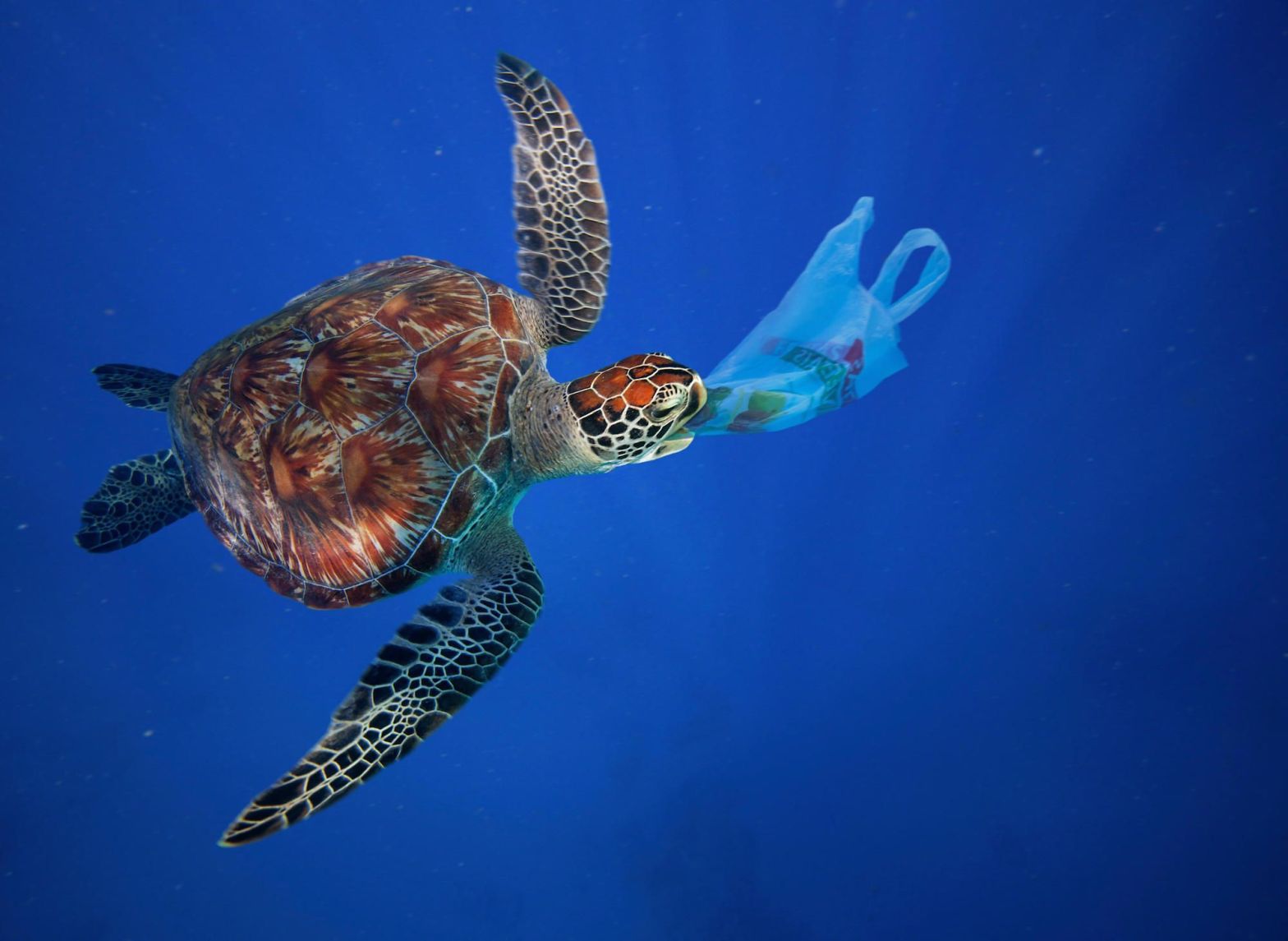
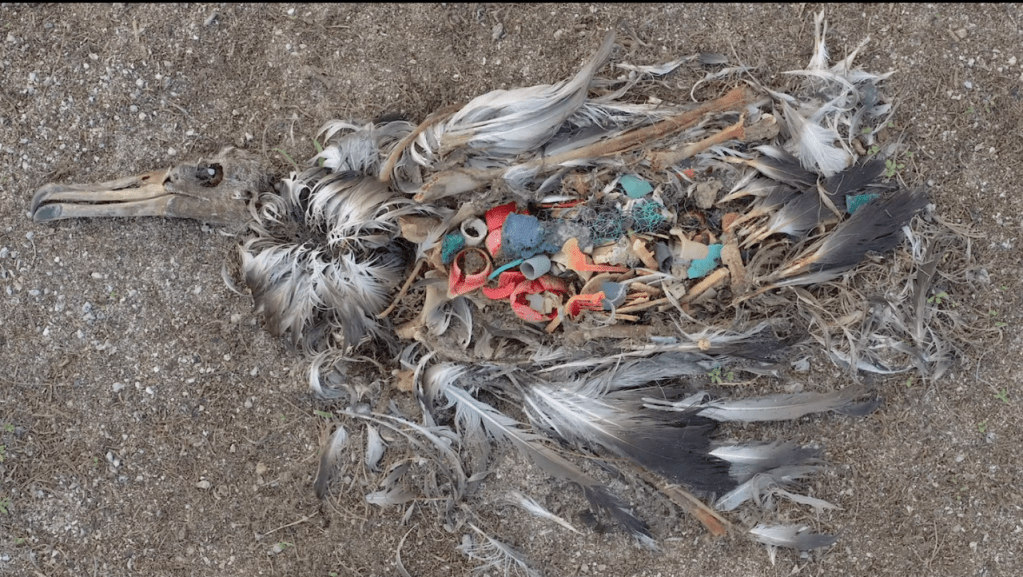
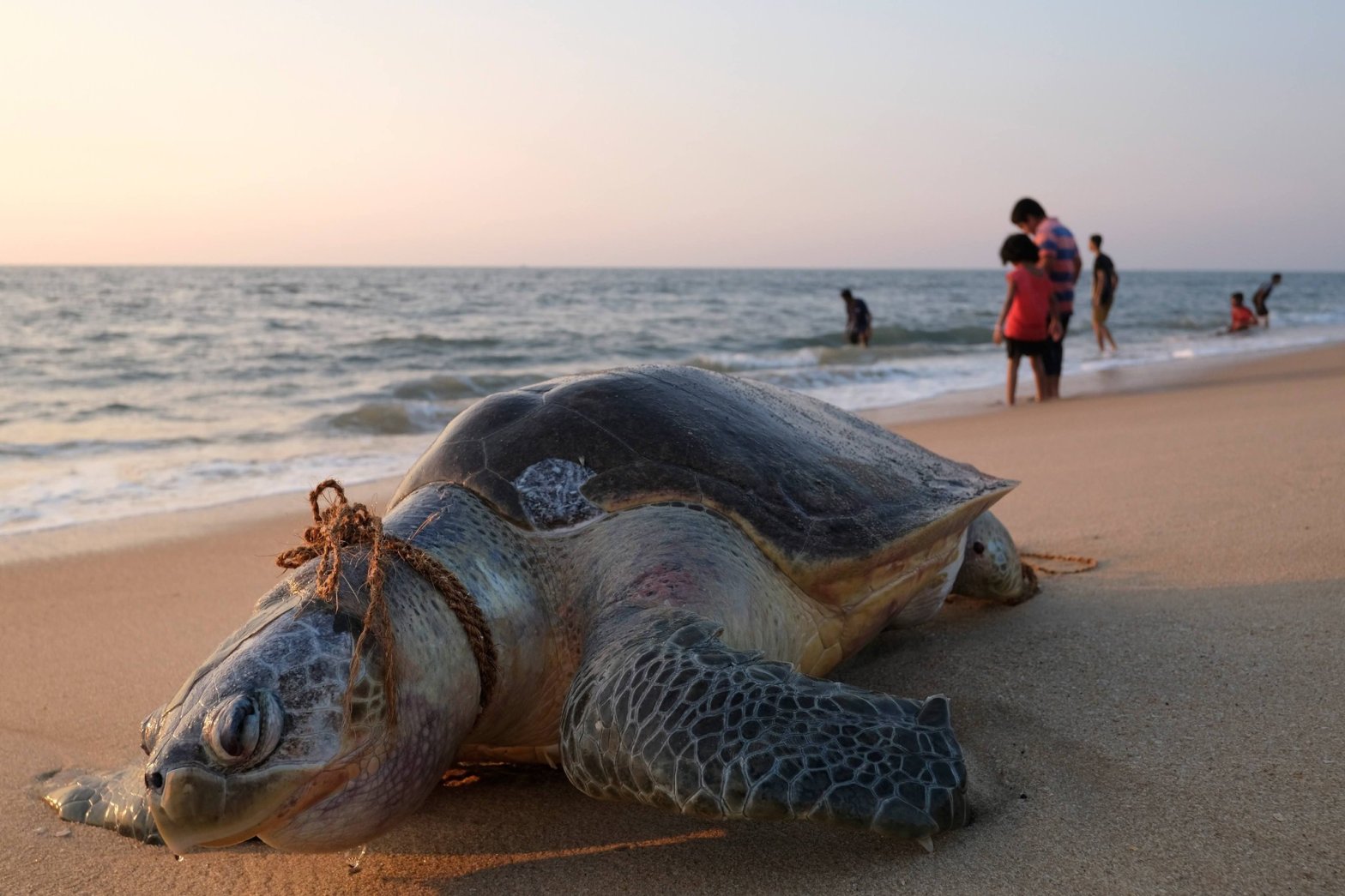
A previous blog post has touched on the topics of ocean pollution already so I do not want to go as in depth as I went on freshwater abuse in this post. Firstly, I want to emphasize just how unprotected our oceans are. In 2019, before the forest fires in Brazil and Australia occured (which isn’t as unnatural as people believed at the time but that’s a discussion for another time), there was an oil spill off the coast of Brazil and as far as I can tell, nobody knows the source of this oil that was blackening brazilian waters and beaches. Whenever I hear about things like this I try my best to look into it and figure out what is going on and I reached out to a number of my Brazilian friends and looked through many online reports on the situation and I could find nothing noting the origin of the spill, it just happened. How is it that an environmental catastrophe that can impact large sections of an entire country’s coast can be so poorly monitored? Because the global society at large has done such a horrid job protecting the oceans. Secondly, the majority of pollution of the Ocean originates from land and of that majority petroleum based products are the greatest contributor. The great garbage patch is largely composed of plastic goods, its plastic bags that sea turtles are mistaking for jellyfish, and it is plastic products that seabirds are mistaking for food and feeding their offspring. 

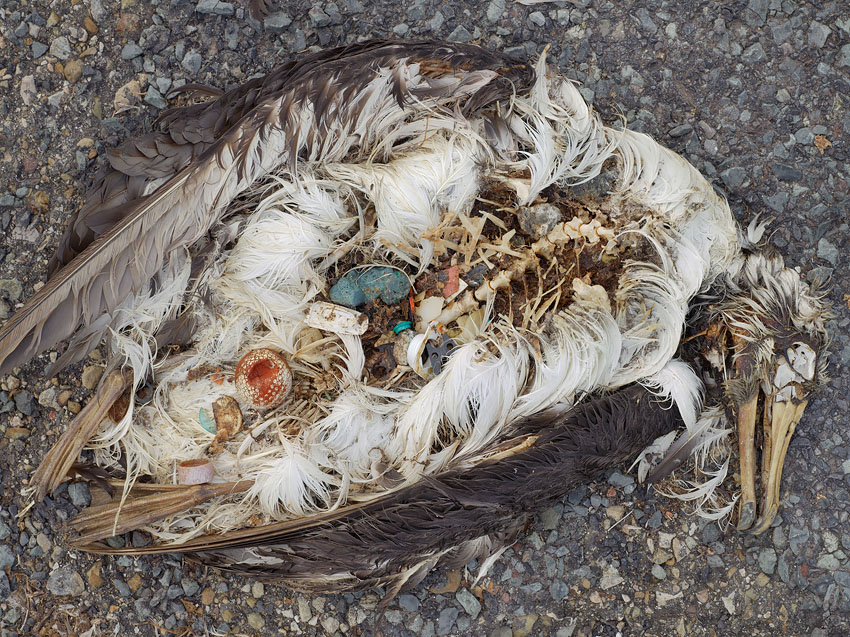
A photograph of a bird carcass filled with plastic waste (4).

Finally, I would like to reveal my own water footprint. Using the advanced individual calculator provided on the site Waterfootprint.org , my footprint came out to be approximately 957m3and although I do not know whether or not this is high for my demographic, I feel it might be skewed due to a misunderstanding of the questions in regard to owning a pool. It asks how often is your pool drained, which I answered once. However, that pool is drained for approximately 9-10 months of the year and is only filled for 2-3 months. But I do not drain it more than once because when it is drained it is completely drained for the majority of the year. Other than that, I primarily eat vegetables, fruit, and dairy products. I only eat meat twice a week and my other water usage rates do not seem very high to me.

Question: What methods can you suggest for pre-emptive measures to combating corporate and agricultural industry abuse of freshwater sources?

Word Count: 1548

Bibliography:

  1. Miller, G. Tyler, and Scott E. Spoolman. 2016. Living in the Environment: Nineteenth Edition, 323-568. Canada: Cengage Learning.
  2. Water Footprint Network. “Personal Water Footprint Calculator.” Accessed April 19, 2020. https://waterfootprint.org/en/resources/interactive-tools/personal-water-footprint-calculator/
  3. https://www.youtube.com/watch?v=1kJf4krMY4A
  4. Jordan, Chris. “Midway: Message from the Gyre.” 2009. Midway: Message from the Gyre. Online Collection. http://www.chrisjordan.com/gallery/midway/#CF000313%2018×24

The Greatest Threat to Humanity was Birthed from its Garbage

Unfortunately, this week we return to Miller’s Living in the Environment focusing on Chapters 17 and 21. The focus of this blog post will be on the hazards and wastes present in our environments and their impact on human health. If there is one thing I will never forget from my childhood, it is the obscenely loud alarm that would ring out periodically each month. That alarm was blasted from approximately 30 miles from where I lived, that alarm came from the nuclear power plant, Indian Point. Many people consider Indian point itself to be a threat to the local communities, however, Indian point has already impacted our community. Indian point is very close to the Hudson river and many people where I live believe that its proximity has contaminated the river and made it not safe to swim in. I do not see this as hard to believe as its known that Indian Point used to deposit its nuclear waste such as expended fuel rods into the Hudson River (it wouldn’t surprise me if they still do), health departments put up warning signs stating that pregnant women and children under fifteen shouldn’t eat fish from the Hudson and other should only do so sparingly, and with those alarms blaring periodically it makes sense that even the presence of the power plant has such a strong psychological impact on the local communities.

This is the main focus of chapter 17 and 21, Miller explicitly details the role of hazards in the environment and how they threaten our surroundings, our livelihoods, and our lives. One of the big transitions in this chapter, is its shift from telling us how the consequences of our actions such as pollution and environmental abuse affect ecosystems and resources to how they impact human life. These chapters focus on the bacteria and viruses that rampage our societies, how chemicals we’ve used persist in the food we eat and the water we drink, and the impacts that our solid waste such as the nuclear fuel rods I mentioned earlier can have impacts that can influence communities for centuries. Probably the greatest enemy of humanity throughout history has been vectors of disease. Whether bacterial or viral diseases have killed the most people throughout history, from cholera to tuberculosis and the Black Death to Covid-19. These microscopic biological invaders have pestered us long before the advent of modern medicine. Miller begins chapter 17 by introducing one of the more recent diseases that has been a headache for modern medicine since its discovery, HIV and aids. Miller explains how viruses “work by invading a cell and taking over its genetic machinery to copy themselves in order to spread throughout the body” (1)  and after repeatedly copying themselves they “cause diseases such as flu and AIDS” (1). It is also believed that “throughout history, more than half of all infectious diseases were originally transmitted to humans from wild or domesticated animals” (1) and historically plagues and diseases rose in areas where animals and humans had frequent interaction such as pre-modern cities. This video by a you-tuber called CGP Grey explains why there wasn’t a reverse epidemic on the old world during the Colombian exchange, and by doing this it explicitly explains how the majority of plagues and pandemics have come about.

CGP Grey’s video essay on why there was no reverse pandemic on the Old World during the Colombian exchange, this explains many of the societal factors that contribute to pandemics and outbreaks.

However, going back to HIV and Aids these are diseases that are heavily associated with the economic disparity of certain parts of the world, “we live in a world where 1 billion people have health problems because they do not get enough to eat and another 1.6 billion face health problems from eating too much” (2 Chapter 12). And this also applies to HIV and Aids, the countries where these are considered epidemics tend to be countries that either do not have or cannot afford to have women’s education, sexual education, the medical infrastructure to provide methods of safe sex and birth control, or they still have high infant mortality death-rates. Infrastructure and the economic ability of countries are two important factors for people looking to go into environmental policy making, environmental infrastructure, or environmental research and the following video explains some of the strains that population demographics represent in terms of hazards to human health and how sometimes culture can be an opponent to what may seem like a reasonable solution.

A video essay by Kurzegesagt explaining the potential overpopulation situation in Sub-Saharan Africa

These chapters are quite topical as what’s mainly on people’s minds and in the news is the coronavirus, a pandemic that has spread rapidly throughout the world. The disease originated in, Wuhan, China and despite what some people believe it did not start from a man eating bat soup, that was a rumor originated on a website called 4chan (infact bats don’t carry this strain of coronavirus, but instead carry strain-14 which did not mutate into Covid-19). Currently, scientists believe the disease may have been transferred from a Pangolin (pictured below), however this is not confirmed. 

Our garbage is another major threat to the health of humanity, and many of us in the first world don’t have the slightest idea of how impactful it can be. We are blessed with not having to visibly deal with our waste in our daily lives beyond throwing it out unless we litter, and we do not always realize that our waste can be hazardous and toxic on its own, and may only be dealt with in hazardous ways as well. In particular, electronic waste or e-waste is a waste almost solely produced in mass by the first world and this waste still obtains many of the valuable metals and minerals used to create things such as computer chips. When we throw these products out, it wouldn’t be profitable or reasonable to not extract those minerals.”The e-waste” that we produce “that is not buried in or incarcerated is shipped to China, India, and other Asian and African countries for processing” and the reason that we export this work is because the “labor is cheap and environmental regulations are weak in those countries. Workers-many of them children-dismantle, burn and treat e-waste with acids to recover valuable metals and reusable parts” (1). Many of our products present a threat to us in almost every step of their existence. The extractions of the materials needed to make them can rapidly deplete resources needed to sustain life, the synthesis of the products can release greenhouse gases and noxious fumes or waste as byproducts, and their disposal can leave toxic waste where its not meant to be, microplastic contamination, and now as shown in this chapter the methods of disposal can expose people to toxic waste as well.

Question: There is always a waste product, are there any methods that could potential make use of these hazardous wastes? If we could use them rather than dispose of them we may be able to mitigate their impact on human health.

Word Count: 1102

Bibliography:

  1. Miller, G. Tyler, and Scott E. Spoolman. 2016. Living in the Environment: Nineteenth Edition, 323-568. Canada: Cengage Learning.
  2. https://www.youtube.com/watch?v=JEYh5WACqEk&t=320s
  3. https://www.youtube.com/watch?v=NMo3nZHVrZ4&t=9s

Food and Dirt: The Crisis the World is Ignoring

At this point I have mentioned my issues with the agriculture industry multiple times in multiple blog posts. To the point where it may have gotten repetitive and annoying. But it is finally here. This week I watched two documentaries that I will link below this paragraph for any readers to watch. The first documentary was Food, Inc, which focused on the inhumanity of the agriculture industry from their treatment of animals to how the monopolies treat farmers in the field and in court. The second documentary was the Symphony of Soil which focused on the formation of soil, how we use it, and the self refreshing ability of ecosystems to restore their soil. 

Currently we have ways of creating compost, which although similar to soil lacks the minerals and non-organic element components that take thousands to millions of years to be produced by internal earth processes. I find parts of Symphony of Soil to be misleading due to how they seemingly interchange the words compost and soil. Penny Livingston-Stark, one of the farmers in the documentary, describes herself as “the sheet mulch queen” and claims to “not grow plants” but instead “grow soil” (1). However, as I have stated before in previous blog posts, we lack a method to synthesize dirt and soil and we are using them at an alarmingly fast unsustainable rate in the agriculture industry. What we do have is ways to create mulch and synthesize “topsoil” which is what Penny Livingston-Stark is actually doing. In the way she phrases what she is doing sounds as if she has found some revolutionary method to synthesize the minerals and inorganic compounds that are virtually impossible to make in one lifespan through regular means in her backyard. Sure, her topsoil can rejuvenate soil a few times for a few extra harvest seasons, however, the world is facing a soil crisis because we are running out of land that can be used to sustain the food needs of our population and currently we have no way of truly refurbishing soil or synthetically creating more.

A large focus of Symphony of Soil is on the organic components that go into making soil and that are literally inside of the soil. This goes from covering the focus of earthworms and their process of creating fertile soil to understanding the organic biomass that must be present in soil for life to be sustained in and on it. One quote from Peter Segger, a Welsh farmer in the documentary, “the organic matter present in this soil has increased, dramatically from about 4 or 5 percent to over almost 18%” he then goes on to comment that “scientist will tell you that this doesn’t work, but it does” (1) and explains how you can see and feel the richness of the soil. Albeit, that is great, organic matter is indeed an important part to soil. However, organic matter is only one part of what makes up soil and it is not the part that we are running out of. Fertilizer, mulch, store brand topsoils, these are all forms of organic matter that you can add to your soil or dirt to rejuvenate it’s deplenishing reserves. But none of these things add the necessary minerals required to truly refurbish the soil, the things that this documentary focus on that help the dirt only keep it usable as long as there are those essential inorganic compounds present within it. This documentary is focusing on solutions that will only delay the inevitable soil crisis and not provide a true solution. I believe that research must be subsidized to create a real solution to our soil crisis.

Symphony of Soil does bring in one very important perspective to understand the arable land crisis, and this is the salinization of farming land. This is an issue particularly in arid areas where we set up agricultural centers such as california. These areas do not have much natural rainfall but their soil is very rich in inorganic material, so we pump water over to them to irrigate and water the fields. However, overtime this water will evaporate and leave salt behind. This salt will kill and prevent anything from growing in those fields for many years, in fact the Romans used to salt the field of their opponents in war and some of those fields have still not recovered. The documentary then cites Dr. David Pimental from Cornell university to explain that “The loss of productive agricultural soils due to salinization equals that now of losses due to erosion” he then goes further by describing that “this is why ten million hectares of land are being abandoned in the world annually, because of salinization” (1).

Dripper lines function as an alternative method to bringing water to inland farms, they are more efficient in electricity and water use. The Symphony of Soil documentary, interviews a farming who claims that nearby farms irrigate about three to four hours of drip whereas his farm that uses the dripper lines, only uses approximately 1 hour of dripping water. Dripper lines are one of the benefits of humanity attempting to maximize the efficiency of farming. However, as the film Food, Inc shows there are many negatives to how we have gone about making agriculture efficient. I’m not one who feels guilty about the mistreatment of animals in factory farms, sure witnessing it makes me feel queasy but nature itself isn’t very “humane” in how predators treat prey. Where I take issues with the meat and agriculture industry is the horrible conditions that factory farm workers are subject too and the amount of chemicals and antibiotics that go into the food we consume nowadays. I wish the film focused more on those two issues, however it does focus on another genuine problem with the industry, the food industry is heavily monopolized.

There is a unique power dynamic at play in the agriculture industry and Food, Inc does a fantastic job presenting it. It hints at it early on in the film by describing how monopolized the food industries are with four companies owning the majority of meat processing facilities and the company Monsanto being the only real option for agricultural support. According to the film, at the time of its release the “the top 4 (beef packers) control more than eighty percent of the market” (2) when in 1970 the top 5 beef packers only controlled twenty five percent of the market. At one point, the documentary attempts to get a tour through one of the animal factory farms and the owner of the farm is at first willing until he is later contacted by his corporate employers (2). The documentary then goes on to describe the corrupt and twisted laws that these companies have lobbied for to protect them and allow them to expand. Monsanto’s farms use genetically modified crops, and they hold the right to sue independent farms if they find that Monsanto seeds or crops have infected that independent farm’s fields (2). I imagine that this cut throat legal method allows Monsanto to sue these farms for their land or will put them in overwhelming debt that their only realistic option is to sell their farms, thus allowing Monsanto to ruthlessly expand and monopolize the industry. The documentary hammers in the disgusting imbalance of power, by interviewing a farmer currently taking Monsanto to court and they hold so much power that he is not allowed to publicly speak and must be shillouted and have his voice distorted so he does not jeopardize his case (2).

This industry is disgusting and is now facing problems that it has proven incapable of finding proper solutions too. A change must be made in this industry, the industry has been making slight changes to become a greener industry but that process must be fast forwarded and it must be able to tackle the modern day problems the industry faces.

Question: Is de-monopolizing the agricultural industry the best way to reach a solution to the soil crisis? Breaking up the monopoly will break up the largest pool of wealth that could be used to subsidize research into synthesizing dirt and adding more voices could potentially make it harder to create a unified voice in the industry to pursue that research.

Word Count: 1381

Citations:

1- Symphony of Soil

2- Food, Inc

How the Supermarket Kills an Ecosystem

This week’s topics are the biodiversity found in the oceans and food production. Two topics that are related to previous blog posts and are heavily intertwined with one another. It makes sense that the ocean is one of the most diverse biomes present on our planet, it is where life is theorized to have originated from. They have had the most time to diversify their populations and furthermore gave way to life on land. And unfortunately for the oceans, the second most complex social structures that the ocean’s paved the way for have not done much but hindered them. Humanity is the master of it’s ecosystems, they change the planet for their own benefit. We have devastated populations, communities, ecosystems, and entire biomes for resources. Arguably, the greatest resources we tear the planet up for is food, we need it to sustain our large population and just like many terrestrial ecosystems we harvest from the ocean too. But worse yet, what is likely our greatest sin against the origin of life is treating the ocean like our own trash can. 

Figure 1: Plastic floating in the ocean from the Great Garbage Patch Source-1

What looks like nothing more than a surface level problem is the greatest threat to biodiversity in the ocean. More so than over fishing and more so than mercury bio-accumulation. The image from national geographic is just a small part of the mass of plastic floating in the pacific ocean, the great pacific garbage patch is an area where the currents of the pacific ocean push debris into and it is an area of approximately 1.6 million square kilometers (1). Our pollution of the ocean has had impacts we never saw coming, as I have mentioned in previous blog posts, species that were completely unknown to us have been discovered to contain micro plastics embedded in their digestive tracts. What I find most terrifying about pollution is micro-plastics, and primarily because we are just beginning research on what effects ingesting micro-plastics will have on an individual animal or human. While I was on a car ride towards one of my research sites last week, I was speaking with some representatives from the Bronx River Alliance and the conversation ended up on micro-plastics and a specific Japanese study on Koi fish. One population of Koi fish were raised in a clean tank, as devoid of micro-plastics as possible, and the second population of Koi fish were raised in a tank with water purposefully containing micro-plastics. The study found three surprising results. The first was that the ingestion of micro-plastics had little to no noticeable impact on the digestion tract. The second was that the micro-plastics that were filtered through the gills showed clear signs of irritating the gills. Finally, the third was that the fish that were raised in water purposefully containing micro-plastics experienced altered hormone levels that disrupted their sexual reproduction cycles. Our pollution has left many macro-plastics out in the ocean that get consumed by aquatic organisms or they break down into micro-plastics and still end up being ingested.

Figure 2: Aquatic bird corpse shown to contain macro-plastics inside of its digestion tract source-2

However, our actions have had other impacts on the ocean as well. Coral bleaching, ocean acidificiation, and another very threatening impact we have is greenhouse gases and particularly in regards to carbon based gases. The ocean is a natural carbon sink that helps balance the natural greenhouse gas emissions that are emitted through the natural process of the earth. However, human caused greenhouse gas emissions are overloading the ocean’s capabilities to function as a carbon sink and are eating away at the carbon available to bond with calcium to form calcium bicarbonate that certain animals need to form their shells. Instead the carbon bonds with oxygen and ends up as dissolved CO2 that doesn’t break down into carbon and oxygen. These threats are overwhelming our ocean ecosystem. But what can we do about it?

The textbook would make us believe that the best method is to enforce laws and policies that would create ocean reserves and mark areas as protected and to protect endangered ocean species. Miller also suggests that community based coastal waste management programs be started and supported (3). However, we all know it is not that simple. Most governments subsidize industries based on lobbyist interests and there would need to be some sort of strong economic incentive for the lobbyist and government to enact policies to protect the ocean and many communities suffer from littering which is something the common place individual does, can we really trust our communities to perform proper coastal waste management without incentive as well? To go further beyond why enacting policies would be difficult, I personally believe it is too little too late for plenty of the species in the ocean. It is impossible for us to remove the effects of pollution from the ocean, almost all fish are shown to contain mercury, an element lethal to living beings in high enough concentrations, and bio-accumulation will only worsen the effects of both of these pollutants. I believe that many of the ocean’s ecosystems will rapidly change as trophic levels of these ecosystems begin to disappear due to bio-accumulation.

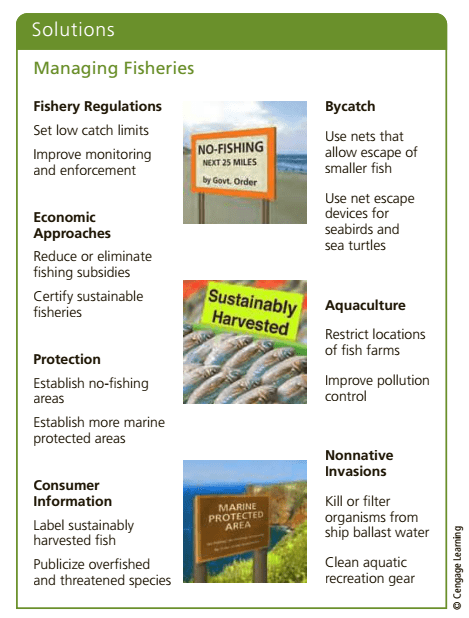
While the text fails to provide a solution to ocean pollution in my eyes, it does offer a proper solution to overfishing. Humans have also directly influenced many of the populations of wild fish in the ocean. From fish trolleys to fish farms we have driven many species of fish to the brink of extinction to sell in markets for people to eat (I find this severely ironic because we’re basically poisoning ourselves with microplastics and mercury but I willingly eat salmon so who am I to speak?). However, our fishing industry is largely inefficient and overly subsidized and likely would not be able to sustain itself without subsidies and if they didn’t receive them they would likely need to become ecologically sustainable. The following figure from the textbook shows many of the ways we could reasonably enforce sustainable fishing (3).

Figure 3: Figure from the textbook describing many ways to make fisheries more sustainable source (3)

What we see in the grocery store has a bigger impact than what we realize. I’ve already mentioned in many of the previous blog posts about the many inefficiencies of farming. However, “…industrialized livestock production generates about 18% of the world’s greenhouse gases– more than all of the world’s cars, trucks, buses, and planes combined.”(3) Factory farming and general farming release methane into the atmosphere which is an incredibly powerful greenhouse gas. However, this also loops back to what I had mentioned earlier with carbonification. Methane is a carbon based gas that also will sink into the ocean and further contribute to carbonification and ocean acidification. Just like many of our other industries, the food industry also contributes to our devastation and destruction of the natural beauty of our planet.

Word Count: 1122

Bibliography

1- https://www.nationalgeographic.org/encyclopedia/great-pacific-garbage-patch/

2- https://www.albatrossthefilm.com/
3- Miller, George Tyler, and Scott E. Spoolman. Living in the Environment. 19th ed.

The Sixth Mass Extinction: Humanity’s Legacy

Humans are masters of virtually every ecosystem except for the deep sea trenches that we have yet to break into, however, even that ecosystem feels our impact. The impact of humanity cannot be understated, even prior to industrialization humanity’s societal developments have been catastrophic for much of earth’s biodiversity. It cannot be denied that during human history, as complex human society develops the ecosystems subject to their impacts have reached “critical tipping points that could abruptly and irreversibly change living conditions on earth” (1). One of the major results of us pushing ecosystems so far is extinction. Extinction is the phenomena when a species is believed to no longer exist outside of the world, regional extinction is when a species has been eradicated in a particular area or ecosystem (2), and finally a third kind of extinction is functional extinction where a species can be found in the wild or in captivity but it cannot perform its regular role in the ecosystem. An example of a functionally extinct species is the American chestnut. The American chestnut can be found in the wild as saplings but whenever this tree reaches a juvenile stage it gets infected with chestnut blight and dies shortly after maturing. Although extinction has occured throughout our planet’s history, in the current epoch humanity’s actions have been the main cause of extinction.

When we think of extinction most people probably think about pandas, tigers, or sea turtles. Animals who are listed as endangered and threatened by extinction because of pollution and habitat loss. All in all its still good to think about these species and what we can try to do to save them, but all of these species are threatened primarily by the after-products of colonialism and industrialization. Corporatism and the rapid expansion of human society is the primary cause of post-industrialization extinction. However, prior to industrialization there were still extinction events. The development of matriarchal nomadic tribes led to the beginning of hunting parties allowing humans to bring down large roaming mammals. Many large mammals went extinct due to human hunting such as the woolie mammoth. People need to understand that the loss of biodiversity and specifically extinction of a species is a permanent loss to the ecosystem and even further a permanent loss of resources for humanity.

Biodiversity is loss primarily in two main ways, through species individually and through the loss terrestrial ecosystems. Currently scientists believe that we are in Earth’s 6th mass extinction. Mass extinction events occur when the earth loses fifty to ninety percent of all life on earth, currently we are losing approximately 10,000 species around the world each year (2) justifying the label mass extinction. This number only gets even worse when we realize just how many species we do not know exist and are already impacting. Although we haven’t yet gotten to those deep sea trenches I mentioned earlier ourselves, the repercussions of our actions certainly have. Researchers using deep sea probes have found pollution such as plastic waste in places such as the mariana trench. Our pollution has gotten so out of hand that researchers have discovered entirely new species that already contain microplastics within their bodies (3). There is no doubt that there are species that humanity has affected that we have not even discovered and that means it’s very likely that there were species we never discovered that died off due to our altering of their habitats or other factors.

Image result for New discovered species with microplastics

Figure 1: Eurythenes plasticus, the newly discovered species containing microplastics (aptly named plasticus for the discovering it had microplastics in it)

Destruction and fragmentation of habitats is only one way that species become threatened by extinction. An acronym was developed to help categorize and label the different human caused threats of extinction, HIPPCO. HIPPCO stands for:

H– Habitat Destruction, degradation, and Fragmentation

I– Invasive Species

P– Overpopulation and an increase in resource consumption

P- Pollution

C– Climate Change

O– Overexploitation

These different factors have great influence on the species throughout the world. I personally specialize in research on invasive species and in particular invasive reptiles and amphibians. The textbook mentions several examples of the common invasives that tend to get the most publicity. Invasive species such as the Burmese Python in florida or the wild boars becoming invasive in urban areas, but it fails to mention what is the most problematic kingdom of life when it comes to invasive species, fungi. Fungi and insects are probably the two most devastating and catastrophic invasive species when it comes to extinction threatening invasive species. The chestnut blight I mentioned earlier is a fungus, and currently the invasive species that is predicted to wipe out the majority of species of amphibian is a fungus. I would go as far as arguing that besides habitat destruction, invasive species are the second most dangerous threat to biodiversity in our current lifetimes (throughout human history it very likely could have been overexploitation aka overhunting).

The textbook somewhat confusingly to me, states that there is another approach to biodiversity loss and extinction, the ecosystem’s approach. Where this is lost on me, is how it fits pretty well within HIPPCO. The text goes very in depth on the exploitation of two ecosystems, grasslands and forests. Most people have heard of it before, slash and burn, clear cutting, selective cutting, the ways we destroy forests and grasslands for agricultural use or for resource exploitation. All of these play into “the temporary or permanent removal of large expanses of forests (or other native plant life) for agriculture, settlements, or other uses” (2)  that the book defines as the cause of the loss of biodiversity through the ecosystem’s approach. We prepare these areas for farming and animal husbandry. I’ve mentioned it in previous blog posts, we are experiencing an arable land crisis. Humanity is running out of dirt suitable for agriculture and currently our only action is to delay the inevitable and cut down forests and grasslands to provide access to arable land. Albeit that our use of ecosystems is a massive problem and have resulted in the loss of many species of plant and animal life that depend on those ecosystems we destroyed to survive, how is this phenomena not related to the habitat destruction, degradation, and fragmentation or the overpopulation and resource consumption or the over exploitation of HIPPCO?

Word Count: 1034

Bibliography:

-Beats, Geo. Global Wildlife Population Declined By 50% In Last 40 Years – Video Dailymotion.  Dailymotion, Dailymotion, 30 Sept. 2014, http://www.dailymotion.com/video/x26ybub.

-Miller, G. Tyler, and Scott Spoolman. Living in the Environment. Boston, MA: National Geographic Learning/Cengage Learning, 2018, 680-695. 
https://www.forbes.com/sites/davidbressan/2020/03/05/newly-discovered-deep-sea-creature-named-after-plastic-found-in-its-guts/#383f1b9a6124

The Environment, Politics, and the Economy: Three things that do not always align

I’ve written many essays, think pieces, and even short stories on political divides I find relevant in global and domestic politics. I’ve written them on divides from past eras and the current one. I’ve written them on racial divides, hierarchical divides, political party divides, and many others as well. But despite majoring in environmental science and only writing those other papers for classes or for my own interests, I have never once attempted to write about the environmental political divisions that society has faced. I have always found the task daunting to approach for two main reasons. The first being that I am far too opinionated on the topic to really give the opposing side a fair voice (not that I am not when writing on racial divisions just that environmental divisions both sides are much more deserving of a voice than that of bigotry), and the second being the conflicts immense complexity. There are many different sides to conservation and environmental policy and it isn’t as black and white as pro-environment and con-environment. There are many pro-environmental movements and theories that are at odds with one another and the same for con-environmental movements. Writing about such a topic when my knowledge is really only surface level beyond the science to it is an intimidating task but alas for a letter grade I will sacrifice whatever dignity I have in writing political thought pieces.

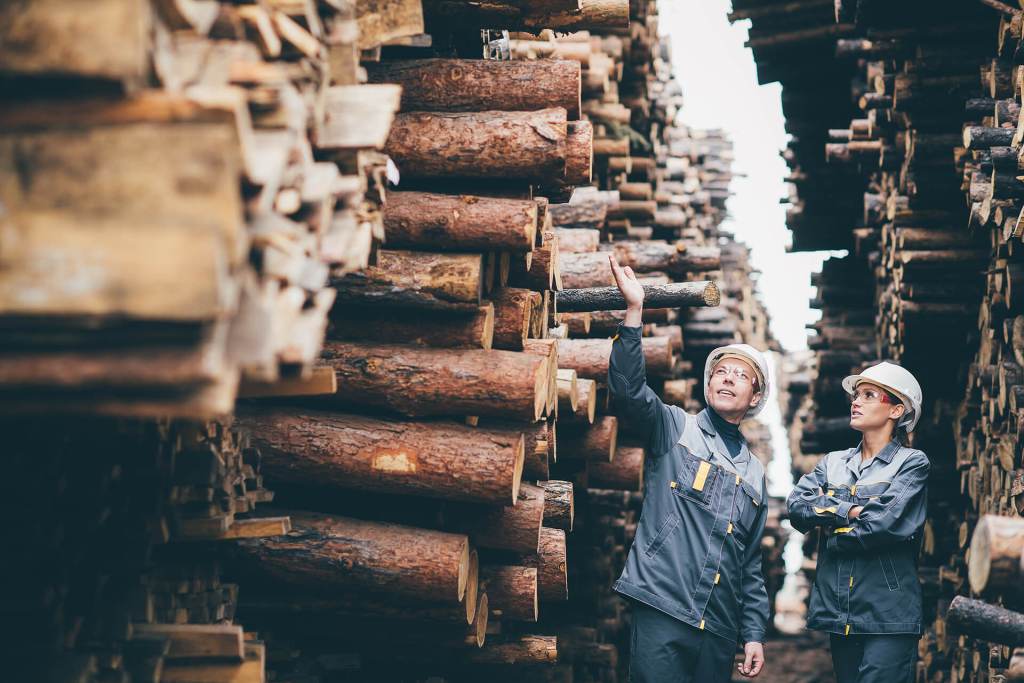
I’m going to start with my critical thinking question as I would like readers to have it in mind as they go through the rest of the blog and attempt to come up with a solution. The emerald ash borer is an invasive species of beetle that is currently threatening to wipe out all north American ash trees. This insect made its way over from south east asia because of lumber imports. At this point most conservation groups and the EPA consider it a fruitless goal to stop the emerald ash borer. I have been reading another book called the Bioeconomics of Invasive Species and in its opening paragraph it mentions that “Most often, however, the damages of invasive species are accepted as a new cost of doing business” (1).

Invasive species are being viewed as a cost of international trade, companies are accounting for them to occur. Is there anyway to provide proper incentive for companies to be preventative? Sure, we can fine companies for letting the invasive occur but I believe it’s proven that fines aren’t the most successful countermeasure to corporate greed.

Economics and the Environment are a dynamic duo that have been making the world turn round since the advent of time. Even though Miller states that economics is “the social science that deals with the production, distribution, and consumption of goods and services to satisfy people’s needs and wants” (2) I would go further and argue the core of economics is the consumption of resources. In their own form competition and species specialization are their own form of economics. However in a specifically human context our economy is limited by the environment’s capacity to provide resources for these goods and services and our policy needs to change to reflect that. To help put this into context, the figure below represents the work of a research team that attempted to show the values of Earth’s resources and functions.

I inherently take issue with their table on the grounds that they “included only renewable ecosystem services, excluding non-renewable fuels and minerals and the atmosphere” (3) and this statement combined with some of their listings comes off as very misleading. Although raw materials and soil are renewable resources plenty are about as renewable as fossil fuels. Currently the world is facing an arable land and phosphorus crisis (which sadly not many people seem to car about). Soil takes 1000 of years to form and we can only revitalize our current soil with fertilizer so many times, and currently we use it at an alarmingly unsustainable rate. Phosphorus is even worse as it is required to form the building blocks which make life on earth possible and the only input of phosphorus the ecosystem has are undersea metamorphic rocks that get pushed to the surface and can take millions of years to form. Neither of these two resources are reasonably sustainable but we use them at an alarming rate and this table puts them next to natural greenhouse gas regulation as if comparing planting a tree is in the same category of renewable as the formation of usable phosphorus.

I believe we need policy that promotes and subsidizes Sustainable business. If we can promote business that have negligible or potentially even positive effects on the environment (4) this could slow down our resource consumption to give researchers the time they need to find synthetic alternatives or ways to synthesize these materials that we are so dependent on. However, this brings me to my next point. Environmental policy needs to subsidize environmental research, I believe it is of the most importance to find the necessary solutions and alternatives to our resource based limitations. The role of environmental law is to protect our environment while also allowing us to use the resources they provide responsibly and sustainably (5). However, some would argue that the law isn’t on our side, Ernest Patridge writes in Consumer or Citizen, that “the road back to authentic democracy will be difficult, for the oligarchs will not willingly surrender their ill-gotten power and privilege” (6) and goes further to state that “a reintroduction of civic education (“Civics” and History), both formal and informal” (7) to empower the citizens and force our democracy back into the hands of the people.

Patridge’s argument has some key flaws in it. Firstly, he claims that there must be a return to an authentic democracy. However, that assumes that there was an authentic democracy in the first place. Our nation, the United States was founded on bigotry, it was never a true democracy. Secondly, Patridge goes on to say that we must break up the media conglomeration and that a fairness doctrine must be enforced (8). Patridge’s fairness doctrine implies that there isn’t a pro-conglomerate sentiment amongst the people of the United States. What happens when we enforce this fairness doctrine and the people immediately reinstate a new media conglomerate? What is the plan then?

Word Count: 1057

Citations:

1- Keller, Reuben P. Bioeconomics of Invasive Species. [Electronic Resource] : Integrating Ecology, Economics, Policy, and Management. Oxford University Press, 2009.

2-  Miller, G. Tyler, and Scott E. Spoolman. Living in the Environment. Chapter 23: Economics, Environment, and Sustainability. 19th ed. Boston, MA: Engage Learning, 2020.

3- Costanza, Robert et. Al. “The value of the world’s ecosystem services and natural capital” Nature Vol. 387, May 1997.

4- https://en.wikipedia.org/wiki/Sustainable_business

5- https://en.wikipedia.org/wiki/Environmental_law

6,7,8- Partridge, Ernest. “Consumer or Citizen?” The Online Gladfly, April 2002.

Philosophical Dipshits Who Think They Know Science

When talking about philosophy or politics I believe it one should be straight up with their audience. I was told by a mentor a long time ago (yesterday) that when it comes to discussing and debating such topics only around thirty percent of the people you will face are willing to be convinced while the others are merely there to oppose you rather than truly have a conversation about the topic. I’m confident I have been in conversations where I was nothing more than an antagonizer to a viewpoint and others where I was open to hearing the other side. I would like to clarify my own socio-political-philosophical alignment to help paint a picture of what you will be getting into reading this blog post. I describe myself as a machiavellian moral cosmopolitan, this essentially means that I believe the ends justify the means if it is too the overall benefit of those affected. 

So what does this mean? What kind of policies and suggestions would I suggest? Essentially, I am for hardlined policies that wouldn’t be popular with mass opinion. New York state just passed a ban on all plastic bags and has applied a tax on plastic bag use while they’re being phased out. Judging from the social media reaction (A totally reliable source for taking your own surveys) it is a controversial enactment. However, I am all for it, I do not care if someone complains that they won’t be able to put a plastic trash bag into their bin. Plastic bags are photodegradable and are the leading cause of microplastics entering ecosystems. I view mitigating the further spread of microplastics as much more beneficial end then helping Marsha’s Sunday night garbage collecting a little quicker. 

Another point I want to make is that I am an environmental science major. I work directly in the stem field and have for most of my highschool and collegiate life been mentored by people from the stem field. For the most part, people in this field have little taste for the discussions around policy making and environmental ethics. I was having a discussion the other day with a good majority of the environmental science program, and the consensus around the room was that the environmental studies program was largely full of “philosophical dipshits who think they know science”. I think this highlights a key issue with the scientific community when it comes to the world views and ethics involved in not just environmental science but science as a whole. The community is cocky and it likes to represent itself with scientific jargon that is hard for people without scientific backgrounds to understand. I believe there needs to be a proper balance between science and rhetoric. On their own they do not get nearly as much done as they could together.

And I grow tired of it, all the political and scientific jargon about all “the assumptions and beliefs…about how the natural world works and how [we should] interact with the environment” (1) that we see in news or articles or on tv. However, it is still important to know and understand this worldviews. Probably the most prominent environmental worldview throughout history that people held was the Human-Centered view. This view considers humans to be the most important species on the planet and should thus “manage the earth mostly for our own benefit” (2). I take a large issue with this worldview, primarily because many of the people who hold this worldview are not educated enough to make the proper environmental decisions that are really for their benefit. Many people who would support this Human-Centered view wouldn’t view our phosphorus consumption as problematic and most likely have no idea how finite of a resource phosphorus really is. Another Human-Centered worldview is the stewardship model, this worldview argues that humanity has an ethical responsibility to manage earth’s resources. Many of the opposing viewpoints to human-centered worldviews believe that all life on earth holds intrinsic value. A species focused version of these kinds of worldviews is the life-centered view, they believe it is humanity’s responsibility to prevent further harm to the other species on earth from our actions . The view I probably would align myself with is the earth-centered worldview, this goes beyond the species protection that the life centered worldview suggests and states that we must protect the “biodiversity, ecosystem services, and the functioning of its life-support systems” as well (3). However, I would like to distinguish my own reasons and opinions on these worldviews. I strongly disagree with the human-centered worldviews, because the people who hold them lack the knowledge to properly judge what is in the best interest for humans. I agree with the life-centered worldviews because I believe those are the world views in which my objective align. I don’t value other forms of life on earth as remotely equivalent to human life, beyond personal bondings, and I have no issue with trying to be in control of nature as best as we can. My beliefs align with those of the life-centered worldviews primarily because I believe it is in Humanities’ best interest to preserve nature and to use the resources it provides sustainably.

There are other worldviews focused on environmental ethics and justice as well but I believe it is more pivotal to focus on one of the underlying issues with environmental philosophy. I’ve mentioned it a few times in this blog already, education. Not just any education, environmental education. The biggest flaw within environmental philosophy and politics is a severe lack of understanding the nature of well, nature and not seeing the real issue. People who support human-centered view are unaware of the essential life-sustaining systems that exist within nature, how those systems provide us resources and keep us alive, and how our unsustainable use of these systems could spell economic or global collapse. While on the other hand, a lot of the people who support more life and nature centered worldviews suffer from a lack of understanding the real issues, being overly concerned with Carbon dioxide instead of other greenhouse gases and the human treatment of animals instead of the extinction threats towards wild animals. The textbook suggests three main concepts to help boost environmental literacy. Miller first suggests that environmental education must teach that natural capital is not only a valuable resource that we must use sustainably but that it also must be maintained to support life on earth. I agree with this concept, however, I feel as if certain topics must be stressed such as our phosphorus and arable land use. He also stresses the importance that environmental education explains that our “ecological footprints are immense and expanding rapidly” (4). I do not believe this is as pivotal as really explaining to people the effects of actions, everyone knows we have an expanding influence on the earth good and bad. It’s all over the news and politics, you would have to live under a rock to not know. The last suggestion the textbook states that environmental education must include is the life support limits of the earth. The earth only has so much space, so much dirt, so much energy at a time, and so much resources to support life. I think this third point kind of blurs into the first one. Understanding earth’s capacity limits fits into understanding earth’s natural capital. Miller argues that if people were educated on these three concepts then they will become more environmentally knowledgeable and aware and thus make decisions based off this newfound knowledge. 

I agree with the textbook on the grounds that we have to increase environmental education. But if we follow the standard environmental rhetoric I believe we will fail to teach people the true scale of our problems. Sure teaching people that eating less meat is a good idea and would help decrease our methane production but then it puts further stress on the arable land crisis. Most of the solutions provided by this kind of rhetoric isn’t perfect and I believe it is very important to stress to people that research must be done to provide better solutions. As of right now there is no alternative to soil and we’re running out of it and as of right now there’s not much research being done on providing an alternative. If we educated people about these issues this could provide incentive for subsidies or companies to sponsor this kind of research as they could possibly see marketing potential.

Word Count: 1417

Citations:

1- Miller, G. Tyler, and Scott E. Spoolman. Living in the Environment. Chapter 25: Philosophical Worldviews and Ethics. 19th ed. Boston, MA: Engage Learning, 2020.

2- Miller, G. Tyler, and Scott E. Spoolman. Living in the Environment. Chapter 25: Philosophical Worldviews and Ethics. 19th ed. Boston, MA: Engage Learning, 2020.

3- Miller, G. Tyler, and Scott E. Spoolman. Living in the Environment. Chapter 25: Philosophical Worldviews and Ethics. 19th ed. Boston, MA: Engage Learning, 2020.
4- Miller, G. Tyler, and Scott E. Spoolman. Living in the Environment. Chapter 25: Philosophical Worldviews and Ethics. 19th ed. Boston, MA: Engage Learning, 2020.

The Strenuous Relationship between the Global Ecosystem and Humanity

Humanity and its coexistence with the global ecosystem have become strenuous since the colonial era. Since then, we have seen the introduction of invasive species, the exploitation of resources, the industrial revolution, and its increase in pollution, and this list can go on and on. However, all these issues can be traced back to one major factor. A factor which is the most significant cause of stress to the global ecosystem, a factor that has no ethically moral answer, a factor that brings into question the biological purpose of life and evolution itself. Population growth.
After the beginning of the colonial period and the advent of the industrial revolution, humanity saw a stark increase in population growth. New technological advances and ideological advances saw a significant increase in quality of life and thus led to longer life spans and lower infant mortality rates. These factors led to a substantial increase in population growth. Fortunately, during the 20th century, the growth rate has declined, but humanity’s population size has still increased (1). This decline was due to many of the first world countries, seeing another increase in quality of life, which in turn lead to lower birth rates. However, this change was not uniform for the entire planet, and many second and third world nations still have a rapidly growing population. Only approximately “2% of the 88 million new arrivals on the planet in 2015 were added to the world’s more developed countries. The other 98% were added to the world’s less-developed countries”(2). The people in many of these countries still have environmental pressures to have multiple children to improve their chances of moving up in life. The issue is that there are currently 7.6 billion people alive on earth(4). If our population continues to grow, scientific data suggests that we would not be able to sustain the resources necessary to maintain our population without having severe adverse effects on the global ecosystem.
Colonialism and the Sphere of Influence period drastically reduced the resources that are now available for the developing countries of our time. Currently, as these nations develop, they’re experiencing internal migrations from rural areas to urban cities. This trend is putting a considerable strain on their already depleted resources, leading to many developing nations not following what we consider the greenest development policies. Many of these nations have forgone ecological thinking and instead followed development and industrialization policies that prioritize efficiency and higher employment rates instead. Currently, much of our environmental focus and policy is on reducing the ecological footprint of the first world. I do not want to imply that I think we should stop pursuing that focus. Still, we must develop greener and more effective industrialization and development policies and processes to entice the developing world into becoming greener.
Currently, 53% of people in developing nations and 81% of Americans live in cities, and this number will only rise as time goes on. But there are some benefits to this demographic shift; this will put a larger amount of the population in better-developed recycling infrastructure and allow previously occupied and destroyed rural ecosystems to recover. Not to mention, there are other benefits as well. Cities provide greater economic opportunity and better education. Having access to these two resources could lead to them having a higher environmental awareness and the financial funds to act on that heightened awareness.
Cities around the world only emphasize the importance of finding a greener solution. Cities “consume about 75% of the resources that we use and produce, and about 75% of the world’s pollution and wastes”(4). These urban centers are not always the economic safe havens we romanticize them to be, and many developing nations see a stark increase in poverty and end up with slums and shantytowns(5). These impoverished sectors of cities can be the cause of a lot of pollution and habitat destruction. However, even the developed parts of the city create pollution. Noise and light pollution are two common types of pollution, along with the mass amount of littering and runoff water that we stereo-typically think of when we think of city pollution(6). Finally, cities can be a severe health risk to their inhabitants and the ecosystems around them. Raccoons have been recorded to live up to 20 years in the wild. However, raccoons that primarily live in the city and eat from city dumpsters and garbage bins are reported to only live for 2-3 years.

Just looking at the world population clock really shows the issue. As of today the population has grown by one hundred sixty thousand plus, and there are still another 6 hours to go by the time I have written this sentence. Most of these new lives will be born in Urban centers and will likely continue the environmental trends that have already been established there.

Now there have been controversial solutions to the first world part of this issue. The steady state economy has been on the forefront of this issue as a solution since around the 1970s. The steady state economy essentially functions as purposefully adjusting your economy in respect to your population to input natural resources and recycling the output  to support your community rather than constantly consuming new resources. A diagram depicting this cycle can be seen below (7): 

Diagram of natural resource flows.jpg

The purpose of the steady state economy is to reduce the stress that first world societies induce on the global ecosystem. However, opponents of this system argue that “resource decoupling, technological development, and the unrestrained operation of market mechanisms” will overcome resource scarcity, pollution, and the population overshoot (8). Its key to notice here that these three methods provide solutions to everything except extortion of ecosystems. However, I do agree with one of their methods. Technological development could unveil the key to providing developing nations greener methods towards industrializing and unlocking even greener methods of managing our society. I believe the steady state economy should allow new resource inputs for technological and research development purposes.

However, the topic has been on people’s minds. A movement called Degrowth has gained popularity among people. The movement is based on “political, economic, and social movement based on ecological economics, anti-consumerist and anti-capitalist ideas” (9). Degrowth activists advocate for the down-scaling of production and consumption. They argue that over-consumption is the cause of long term environmental issues and social inequalities (10). It is important to understand that the degrowth movement’s reduction of consumption does not require a decrease in well-being (11). The core of degrowth is to minimize first world societies’ resource consumption and to force companies to pursue greener policies through ideologically active shopping and consumption.

Question: How can we learn from a developing nation such as Costa Rica that has such a low ecological footprint to create green policies for other developing nations to follow?

Word Count: 1136

Bibliography

1- Miller, George Tyler, and Scott E. Spoolman. Living in the Environment. 19th ed.

2- Miller, George Tyler, and Scott E. Spoolman. Living in the Environment. 19th ed.

3- Miller, George Tyler, and Scott E. Spoolman. Living in the Environment. 19th ed.

4- Miller, George Tyler, and Scott E. Spoolman. Living in the Environment. 19th ed.

5- Miller, George Tyler, and Scott E. Spoolman. Living in the Environment. 19th ed.

6- Miller, George Tyler, and Scott E. Spoolman. Living in the Environment. 19th ed.

7- https://en.wikipedia.org/wiki/Steady-state_economy

8- https://en.wikipedia.org/wiki/Steady-state_economy

9- https://en.wikipedia.org/wiki/Degrowth

10- https://en.wikipedia.org/wiki/Degrowth

11- https://en.wikipedia.org/wiki/Degrowth

Understanding the Environment through our Understanding of History

Big History is a method of teaching history about the origins of the Universe and the events that have taken place during its existence. One of the unorthodox aspects of Big History is its lack of emphasis on Human history and how instead it fits that history into the larger context of the universe and history of Earth as a whole (Spier, 2008). Big History pulls from many of the physical and social sciences such as biology, astronomy, geology, climatology, prehistory, archaeology, anthropology, evolutionary biology, chemistry, psychology, hydrology, geography, paleontology, ancient history, physics, economics, cosmology, natural history, and population and environmental studies as well as standard history (Eakin, 2002).   Big History’s advantage over conventional history is that it does not provide such a bias towards human history and teaches more about the entirety of Earth’s history. However, there are a number of criticisms of big history such as being “anti-humanist” (spiked-online.com, 2016) as well as not following conventional history standards and instead appearing as more of a telling of evolutionary biology and quantum physics (Sorkin, 2014). There are four main themes other than the sciences listed earlier related to Big History. Time Scales and Questions: A concept of Big History that makes comparisons based on different time scales and notes similarities and differences between the human, geological, and cosmological scales. Cosmic Evolution: A telling of history that focuses on the many changes in composition of radiation, life, and matter in the history of the universe that lead to the creation of humanity and its achievements. Complexity, Energy, Thresholds: A concept in which as the energy increases within materials in the universe increases so does their complexity until they reach a complexity threshold before creating something new in the timeline of Big History. Finally, Goldilock Conditions: These conditions can be described as the conditions required for any complexity to form and continue to exist such as how humanity requires the right temperatures to survive.

The Map directly above shows a temperature gradient with red areas being the hottest and the pink regions being the coldest. Comparing the two maps above showcases the Goldilock conditions. We can see a clear correlation between the complexity of human society and the proper temperature conditions.

Another and more widely accepted way of analyzing the Earth’s natural history, is through the geological epochs. The Anthropocene is “a proposed geological epoch dating from the commencement of significant human impact on Earth’s geology and ecosystems, including, but not limited to, anthropogenic climate change” (Anthropocene). Another term used to describe this epoch is the Homogenocene which is meant to imply more focus on the diminishing biogeography and biodiversity of ecosystems. This was initially caused through “human predation” and this “was noted as being unique in the history of life on Earth as being a globally distributed ‘superpredator’, with predation of the adults of other apex predators and with widespread impact on food webs worldwide” (Anthropocene). The globalization of human trade took it further because it led indirectly and directly to invasive species spreading around the world. These invasive species play a large role in decreasing global biodiversity. Human activity has also led to the rapid displacement of many animal species into ecosystems and niches they are not well adapted for.

 We can also tell environmental history through conventional history. Jared Diamond describes what leads to the collapse of society in his book Collapse: How Societies Choose to Fail or Succeed. In his book, he defines five factors that lead to the decline of a civilization. However, three of these five factors are environmental issues. These three factors are climate change, environmental problems, and how societies react to the other four factors. Diamond’s book focuses on an environment’s carry capacity as a significant environmental problem that leads to overpopulation and then eventually, the societies’ collapse.

The next segment of the summaries covers U.S environmental history. There are four distinct periods in U.S environmental history, the Tribal era, the Frontier era, the Conservation era, and the current era. The Tribal era was the period that Native Americans lived in North America before the 1600s when European settlers began to arrive. The Frontier era lasted from 1607 to 1890, in which European colonists began founding communities and viewed the natural resources as inexhaustible and nature as something to be conquered and tamed. Early Americans started showing concerns about exhausting U.S resources and went as far as arguing that unspoiled wilderness on public lands should be protected. The government and private citizen sponsored programs began serious focus on conservation programs in the United States during the current era, and these efforts only increased as the era continued. A significant turning point that distinguished the present era from that of the conservation era and frontier era was the Forest Reserve Act of 1891 that put more responsibility on the United States government to protect public lands from resource exploitation. Eventually, during the early twentieth century, two schools of thought came about regarding conservation. The first was the conservationist who believed in preserving the United State’s public lands for science and efficient use and sustainable extraction of resources. The second was the preservationist, who thought it was the government’s responsibility to protect the United State’s public lands in a natural state with no interference.

The rise of U.S environmentalism quickly rose among the united states populace after World War 2. The primary belief of environmentalism was that industrial production and its following patterns of consumption created ecological instability that could bring the viability of modern societies in question.

My first reaction to the Big History concept has to be agreeing with some of its critics. It does seem difficult to distinguish what a physics or biology class would cover and what Big History would cover. However, despite the seemingly deep intertwining between Big History and other fields of science, I do believe there is a place for it when discussing history. Despite not being human history, concepts such as geological dating for epochs show similarities to how we record conventional history. Archeologists use carbon dating to identify what period a human artifact is from using the same procedures they would use to determine which epoch a dinosaur lived. I do not think Big History should outright replace conventional history; conventional history is convenient for focusing on the achievements and actions of humanity. However, I think there should be some intermediate mix between Big History and conventional history that can focus specifically on the growing influence humans had on Earth’s geology and ecosystems during the conventional history periods.

I think that this intermediate mix of the two would look something similar to the U.S environmental history readings we read for this blog post. That reading focused on the political aspects and developments that influenced the environmental philosophies and policies that were present and passed in the United States. However, I believe that it would be better to focus on what actions people took that lead to our harmful influence on the Earth’s ecosystems and geological resources.

How do ancient American societies fit into Diamond’s five factors of collapse? How would cities such as Cahokia, Tikal, and others that do not have any definite signs for a cause of decline be categorized?

Word Count:1158

Bibliography:

 Fred Spier (2008). “Big History: The Emergence of an Interdisciplinary Science?”

 Emily Eakin (January 12, 2002). “For Big History, The Past Begins at the Beginning”. The New York Times. Retrieved 2012-12-13.

 ‘Big History’: the annihilation of human agency”. http://www.spiked-online.com. Retrieved 2016-02-28.

 Sorkin, Andrew Ross (2014-09-05). “So Bill Gates Has This Idea for a History Class …” The New York Times.

Design a site like this with WordPress.com
Get started