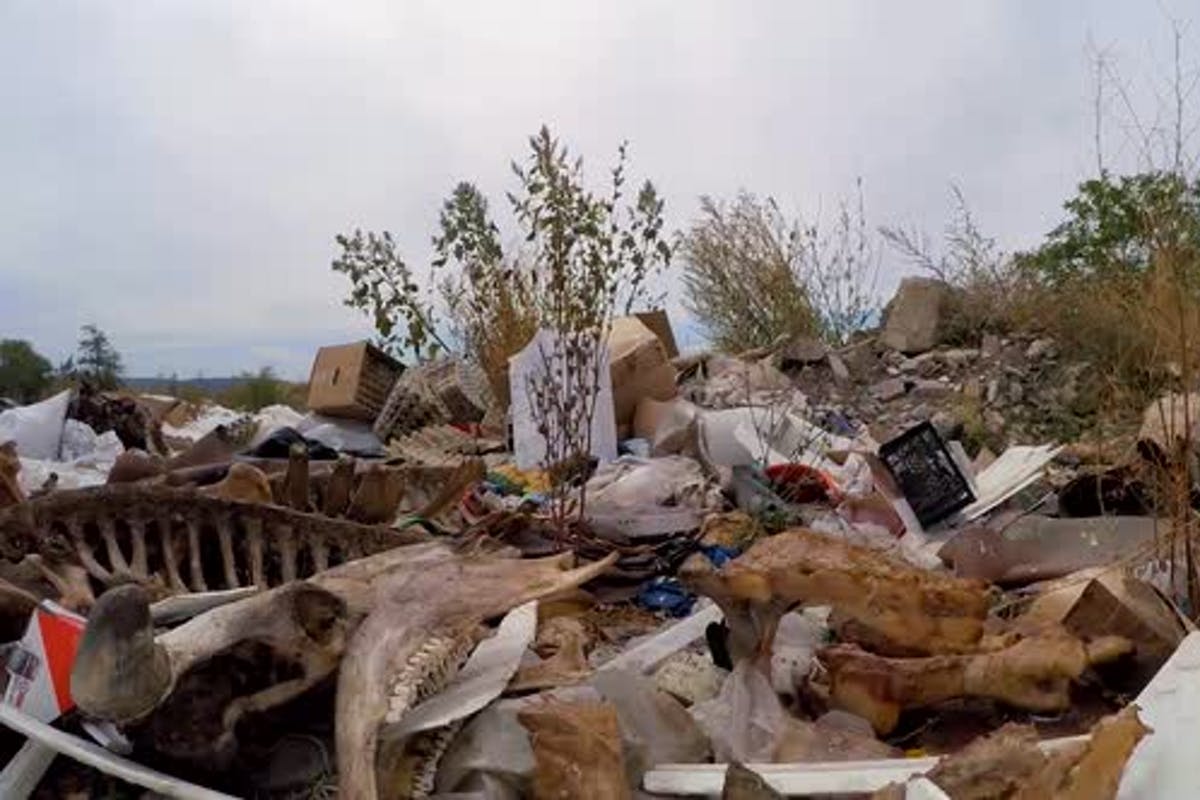
Our final topic for this series of blog posts is focused on a passage from The Human Planet: How We Created the Anthropocene, specifically on chapter 11. Here the authors discuss the three outcomes they believe humanity will reach as we continue civilization on earth. The first is we continue in our “capitalist” society but manage to mitigate environmental impacts either through artificial means or through being much more efficient, less destructive, and or conservative in our use of the environment. The second outcome they believe may happen is that we have a complete and total revamp of our society’s ideologies and values and move towards a much more green friendly society that has values that are in line with benefiting the greater ecosystem of the planet. And finally, what is probably the most bleak outcome of society is its collapse due to our destruction of the earth leading to the planet becoming near uninhabitable or making resources so scarce that conflict naturally consumes our capitalist society. We will go through each of these outcomes individually, beginning with the first outcome.
The authors, Simon L. Lewis and Mark A. Maslin, argue that the first outcome is the least likely due “the simultaneous rapid increases in the number of people, level of energy provision and quantity of information being generated, being driven by the positive feedback loops of reinvestment of profit, and ever-growing scientific knowledge” (1). Although I do disagree that this is an unlikely outcome, I also think that their argument for why it is unlikely is somewhat misleading. The main issue I find misleading is “rapid increases in the number of people” (1) in the video I linked in a previous blog post on the population issues in sub-saharan Africa it provided sources and stated that most areas in the world are actually experiencing population declines and that we are already past the peak of the population boom. Although our population is still growing globally, the theory of the demographic transition has already been proven, as nations go through the developing process they will naturally begin declining in population. The UN even estimates that the population is not likely to go far past 11 million people and went as far as to say that they estimate the twelve-billionth person will never be born. I will provide another video from Kurzgesagt focusing on the human population crisis specifically.
Where I do think the current system fails is due to the inherent beliefs of capitalism, the need to make the quickest and best profit. The means to green infrastructure are here, Costa Rica has one of the quickest growing industrial sectors providing their country which has lowered Costa Rican unemployment rates. Now Costa Rica is a country that had no pre established industrial sector, imagine the amount of jobs that would be created from upheaving the current non-green infrastructure system and then creating the new green infrastructure. So what is keeping our capitalist society from moving on to these systems now? Are they less efficient? No, infact its the opposite, green energy is proving to be more cost effective and efficient than oil, green construction is proving to be more energy efficient and cheaper to build than conventional constructions, and greenscaping can provide an extra produce for companies to export. So then what is the issue? The real issue is that it would cost money to replace the current systems and taking a large expense for a greater profit is viewed as a risk, these large companies don’t want to change for a profit because they are making a profit without what they see as a risk.
I do think that if this outcome does occur, it kinda brings into question whether or not this is really the first outcome, or the second outcome. I personally believe it will be a mesh of the two. Many of the beliefs of capitalism will be brought into question and abandoned and our new ideology will be in line with what benefits the earth but it will still be powered by the desire for profit, just a much greener profit. I do think this outcome is unlikely though, mainly on the grounds that it still requires serious developments in agricultural research. Specifically, as I have mentioned so many times before in these blog posts, the necessity of developing an alternative to dirt or a new faster way to produce it. Dirt is technically a renewable resource just it takes an unfeasible amount of time to naturally generate to support our food production needs.
The main meat of the argument Lewis and Maslin approach the second outcome with is the idea of revamping our society to move away from a capitalist society and instead focus on our government supporting its people. One of the first things they suggest the global society should implement is universal basic income which “breaks the link between work and consumption, and so lessens environmental impacts. We could work less and consume less and still meet our needs” (1) thus removing the focus on profits and instead focus on providing for needs. This would in theory, drive down competition and resource consumption as we focus on providing people what they need. In turn, these decreases would allow us to direct the global economy to accomplishing the “expectations” of the Paris Climate Agreements “that high-emitting countries will do more than others to reduce their emissions, and that income poor countries will receive financial payments and technological assistance to build renewable energy systems fit for the twenty-first century alongside investments to help them adapt to the inevitable climate change impacts they will face” (1). However, this is sadly nothing more than a pipe dream in my eyes. There are three reasons that I feel this way. The agriculture industry is the main issue I have with this outcome, this industry is one of the leading environmental polluters and this outcome provides no method to solving the arable land crisis that the world is facing. Infact, I think the lack of capital will decrease funding for research on new innovations making it less likely to find a solution to our crisis. I also think that the lack of desire for profit will lead to a lot of farms focusing on providing on a local scale rather than a global scale leading to many areas of the world lacking suitable farms for their large populations. The second issue is that this solution completely ignores the geopolitics of the world, certain countries only hold power due to their industrial or natural capital. Saudi Arabia has so much influence over global politics purely because of its oil production and with its vast capital, countries like that will never let such an upheaval of the global economy ever occur. Finally, the last reason is that this couldn’t happen on the grounds that it’s just purely not suitable for how politics and systems of power function. Rulers and democracies function through key supports, these keys help them come to power and to stay in power they must satisfy these keys (2). This is the reason why many politicians that we elect end up going back on their word, they have to keep certain groups or people happy or else they will lose their power (2). If someone in charge of the US was to enact these delusions of grandeur they will just be voted out of power for not rewarding the keys that keep them in power. I suggest you read the source I am paraphrasing, The Dictator’s Handbook: Why Bad Behavior is Almost Always Good Politics, if you would like to really understand this argument on how maintaining power functions.
So this leaves us to the final outcome, the destruction of society due to our environmental impacts. I believe this is the most likely outcome and I believe it is already occurring. I believe we have irreversibly impacted the planet due to microplastics, petroleum has been such a headache of a discovery. Microplastics are inside of just about every organism and we have even discovered completely new organisms that already had microplastics within them. We do not completely understand the impact of the consumption of microplastics but every fiber of my being tells me they can’t be good. The extent to which we are exposed to microplastics is virtually impossible to combat at this point, microplastics were discovered in denver rainwater, this ever so “convenient” invention has impacted our planet in more ways than I think we will ever understand and it it turns out that it can have negative impacts on human life I believe it is so heavily integrated within our planet that it will be impossible to reverse.
This is sadly my last blog post for my environmental studies class, and although I started this blog for the sake of a grade and in the beginning, from the perspective of someone who’s written research papers and theory-defense essays, even dreaded the class on the grounds that I thought writing a blog post was a waste of time. However, I have come to enjoy the periods of time spent on just writing my thoughts on certain topics in a less professional manner and have even felt it be somewhat therapeutic. I’ve even expanded some of the topics that my blog posts have been focused on to go beyond the scope of the class giving my own sources to video essays on things like geopolitics that play a role as well in the environmental policies we see enacted. Hopefully, this is not the end of this blog as when I have the time I will try my best to periodically update it on my environmental research, environmental topics I have read about or am interested in, and perhaps expand it to further topics of interest of mine. I would like to thank my Professor for introducing me to this new outlet of creativity and hopefully, I continue to use it more.
Question: What do you believe is the most likely outcome? And if you believe outcome two is the most likely, how would you argue against the three main points I make against it?
Word Count: 1697
References:
1-Lewis, Simon L., and Mark A. Maslin. “Chapter 11: Can Homo Dominatus Become Wise.” In the Human Planet: How We Created the Anthropocene,
2-Mesquita, Bruce Bueno de, and Alastair Smith. The Dictator’s Handbook: Why Bad Behavior Is Almost Always Good Politics. PublicAffairs, 2012.
 Environmental Studies and Science